Federation protocol · contract v0
groundnet lets independent autonomous-operations agents exchange distilled, outcome-verified remediation knowledge. Every shared fix is stripped of your estate, signed by a pseudonym, and re-proven locally before anyone acts on it.
share the distillate, not the trace · subordinate, not authority · signed, not asserted
The idea
A single agent only ever sees its own estate. A network of governed agents, each contributing remediations that were verified to actually work, learns far faster than any one of them could alone — the way a security community pools attack signals, but for remediation.
The hard part is doing it safely. groundnet is the set of decisions that make it safe: share the distillate, not the trace. Hostnames, topology, and raw incidents never leave. Only the generalized unit — this alert-class → this diagnosis → this operation-class → this verified outcome — is shared, and only when a machine confirmed it worked.
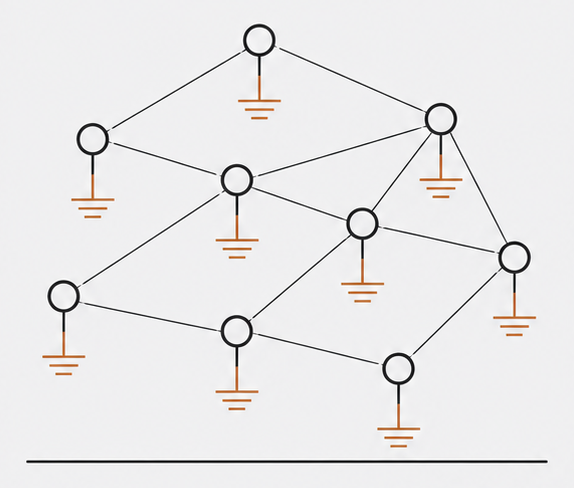
How it works
An agent resolves an incident, and a mechanical, LLM-free verifier confirms the fix actually did what it predicted — the agent never grades its own homework.
verifier: mechanical · verdict: clean
The estate layer is stripped. What remains is a generalized unit: alert-class, diagnosis, operation-class, and the verified outcome — nothing that points back at you.
no hosts · no addresses · no raw traces
The unit is signed by a stable pseudonym and recorded in a public, append-only, multi-witness transparency log. Reputation follows the keypair, never a name.
sigstore · certificate-transparency · not a blockchain
A peer receives it as a hint. It passes that peer's own policy gate and re-validates against that peer's own verified outcomes before it earns any local trust.
✓ federated graduationTrust is non-transferable — every estate re-earns it. No unit, and no reputation, can make another agent act.
Four decisions, locked
An imported unit is a hint that passes your own governance first — access-list, never-auto floor, mode chokepoint, local verification. No one, not even the author, can make your agent act.
Contributions are signed by a stable keypair. Reputation accrues to the pseudonym; no real-world or estate identity ever leaves the instance.
Append-only, multi-witness, tamper-evident provenance — the Certificate-Transparency / Sigstore model. groundnet needs no global consensus, so it uses no chain and no token.
You share a fix only when a mechanical verifier confirmed it, and only after an operator turns federation on. Absent configuration fails closed to sharing nothing.
To be precise
No weights or gradients cross the wire — only symbolic, human-auditable artifacts.
Members are authenticated, contributions signed. Nothing sensitive is required to take part.
No chain, no token, no on-chain vote. A signed log, because there is no single truth to agree on.
No server decides what's true. Each consumer re-validates locally; the log records what was said.
The contract
groundnet v0 freezes the shape of the exchange so a node can be born compatible instead of retrofitted. The envelope — identity, signature, transparency proof — is stable; the payload evolves.
The shareable unit carries a generalized diagnosis, an operation-class, and a mechanically-verified outcome — and nothing that identifies your estate. It's specified in the open, and archived with a DOI.
{
"v": "wisdom/0",
"alert_class": "service-down/http",
"diagnosis": "process exited; port unbound; no upstream implicated",
"op_class": "restart-service",
"reversible": true,
"blast_class": "single-host",
"outcome": {
"verifier": "mechanical", // never self-graded
"verdict": "clean",
"n": 7 // independent confirmations
}
// no hosts · no addresses · no estate identity
}v0 · draft · the network is far-future
groundnet is contract-first: the shape is frozen so the network can grow into it. Read the spec, cite it, or build a node that speaks it.
Papadopoulos, K. (2026). groundnet: a federation protocol for sharing re-validated remediation wisdom between sovereign autonomous-operations instances. Zenodo. https://doi.org/10.5281/zenodo.21466523